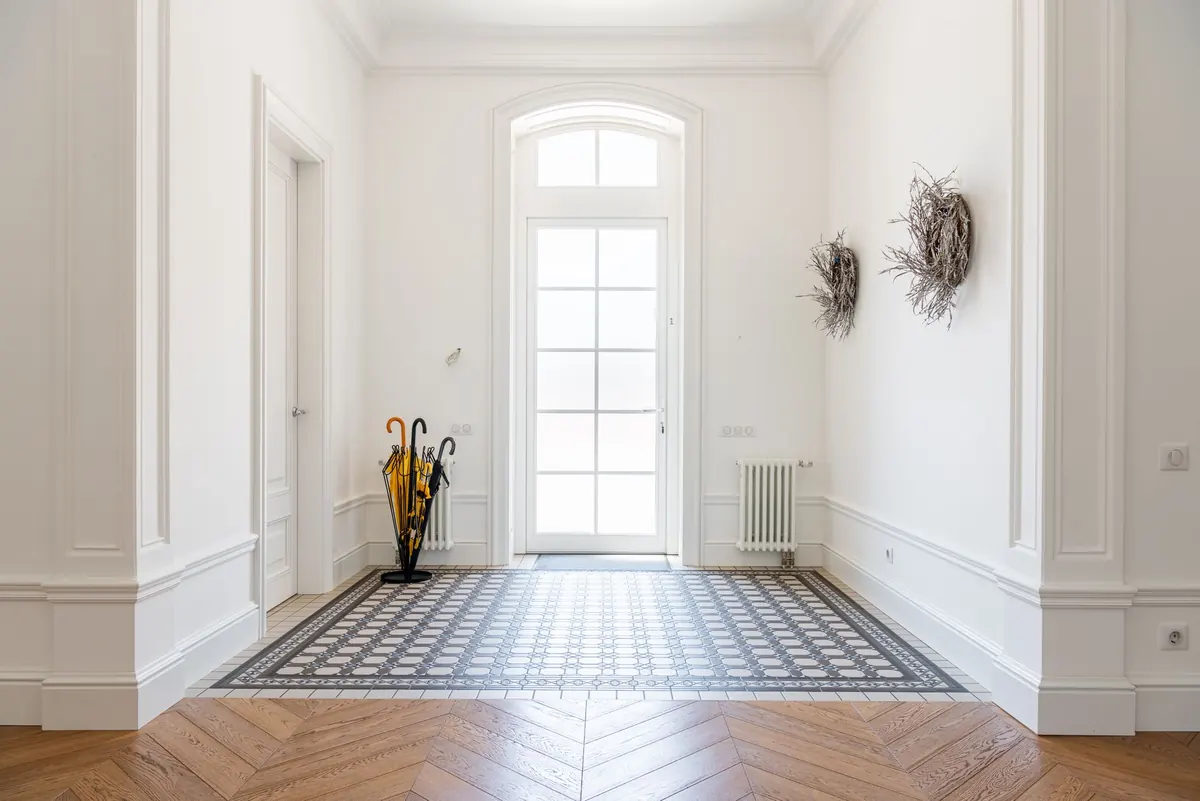
Most umbrellas don't die in storms. They die on the floor by the front door, crushed under a bag, borrowed and never returned, or left on a bus seat because there was nowhere sensible to put them. The fix isn't a fancier canopy. It's a handful of small accessories that give an umbrella somewhere to live and something to hold on to.
A stand solves the problem that causes most umbrella damage: the umbrella lying on the floor. A good freestanding stand holds four to ten closed umbrellas upright, keeps the wet canopy off your flooring, and makes the umbrella easy to grab on the way out. The ones that work have a weighted or broad base so they don't tip when empty, and a removable drip tray at the bottom. Empty that tray after wet days and rinse it now and then. Standing water is what rusts a steel base and sours the air in a small hallway.
Height matters more than capacity. Long walking canes need a stand roughly 50 to 60 cm tall so they don't lean and sag against a wall. Folding umbrellas are happy in something shorter and slimmer, which suits a narrow entryway. If you rent and can't drill, look for a slim cylindrical stand with a heavy base and a rubber ring underneath to protect the floor. Place it beside the door rather than behind it, so nobody has to step around a wet umbrella to get inside.
Every umbrella arrives with a sleeve, and almost every sleeve disappears within a month. Replacing it is one of the least expensive things you can do for an umbrella you actually carry. A cover keeps a wet canopy from soaking the inside of a bag, keeps grit and sand out of the fabric, and stops a folding umbrella from springing open in a suitcase.
Look for water-resistant fabric, a drawstring with a toggle rather than a narrow ribbon, and a bottom that opens or vents so air can move. That last detail matters. Seal a soaked umbrella in an airtight sleeve and you get a musty canopy that smells every time you open it. The routine is simple: wipe the canopy, dry it open at home, then sleeve it. Out in the rain, sleeve it wet and take it out again as soon as you're back indoors.
A small cord tying the cover to the handle is worth having, because a cover attached to the umbrella is far less likely to be lost. So is a name tag or a strip of coloured tape if several people in the house own similar umbrellas. Keep a spare sleeve in a desk drawer or the car. A folded umbrella that won't open properly because it is full of crumbs and grit is a small annoyance you can easily avoid.
A wrist leash is a loop of cord, webbing or elastic that attaches near the handle. You slide your hand through it and the umbrella is tethered to you. On a gusty day the canopy may still flip, but the umbrella won't leave your grip and end up in the road. It also buys you free fingers: you can carry a coffee, hold a child's hand, unlock a door, or check your phone without wedging the handle under your chin.
Choose a strap wide enough not to cut into your wrist, adjustable so it fits over a coat sleeve or a glove, and attached with a proper clip or screw fitting rather than a flimsy split ring. If you walk long distances or commute with a bag, a strap that converts to a shoulder carry is genuinely useful, and some handles include a small eyelet for exactly that.
Crossing a windy bridge. The school run with a child on each side. Walking a dog with the lead in one hand. Managing a suitcase and a train ticket. Anyone who has watched an umbrella blow inside out in the middle of a junction already knows the value of a simple loop of cord. One caution: don't swing an umbrella by the leash, since the stress goes straight into the weakest point of the handle.
Hooks are the space-saving answer in small flats and busy hallways. A row of them inside a coat cupboard or on the side of a bookcase keeps umbrellas off the floor, out of the walkway, and in sight when you need one. The trick is choosing the right hook. Wide, rounded hooks and two-prong designs hold a folded canopy without leaving dents, while thin wire hooks concentrate pressure on a single spot and will crease a wrapped umbrella over time.
Plan the height before you drill. A full-length cane hanging from a hook needs roughly a metre of clear space below it, so measure your tallest umbrella and add a few centimetres of clearance. Space hooks 8 to 10 cm apart so handles don't tangle. Fix into a stud or use the correct wall anchor for plasterboard, and treat adhesive hooks as suitable only for light folding umbrellas, within the weight limit printed on the packet. Over-door racks work well in rented flats, provided the door still closes and the metal doesn't scrape the frame.
Beyond the big four, a few inexpensive items make the whole system work better.
Photo: Max Vakhtbovych / Pexels