A wet shoulder is rarely the umbrella's fault. It is almost always a sizing problem. Walk into any shop and you will see canopies labelled 42 inches, 55 inches, 62 inches, with nothing on the tag explaining what that means for the person standing underneath. The good news is that picking the right size takes about two minutes once you know which measurement to trust and how much dry space you genuinely need.
Two measurements describe every canopy, and shops rarely use them consistently.
Arc is the distance measured along the curve of the fabric, from one tip, over the top of the dome, to the opposite tip. It is the larger number, and it is the one printed on most labels because it sounds more impressive. Diameter is the straight-line span across the open canopy, edge to edge, as if you laid it flat on the floor. It is the number that actually tells you how much of you is covered.
Because the canopy curves, the arc always exceeds the diameter. On a typical umbrella, expect the diameter to run roughly five to eight inches smaller than the arc. A canopy sold as a 55-inch arc usually opens to somewhere around 47 to 50 inches across. So when you compare two umbrellas in different shops, check which figure each one quotes. A "50-inch umbrella" that is really a 50-inch arc is a noticeably smaller thing than one with a 50-inch diameter.
Rib count matters too, but less than people assume. Eight ribs gives you an octagonal canopy. Ten or sixteen ribs rounds out the shape and spreads tension more evenly, which helps in wind, but it also adds weight and cost. For most people, rib count is a comfort detail rather than a coverage one.
For a single adult walking, a canopy with a 40 to 46-inch arc covers the essentials: head, shoulders, and a bag held close. That is the classic compact folding size, and it is genuinely enough on a still day.
Add wind, though, and the maths changes. Rain rarely falls straight down. When it drives in at an angle, you tilt the umbrella toward the weather, and the edge that was over your shoulder swings away from it. That is the moment a small canopy stops working. If you walk to work in a city, or you carry a laptop bag on one side, step up to a 48 to 52-inch arc. The extra inches do not sound dramatic on paper, but they are the difference between a dry back and a damp one.
Height plays a part as well. A taller person holds the canopy higher, which exposes more of the shoulders to angled rain. If you are over about six feet, lean toward the larger end of whatever range you are considering.
This is the size that disappoints most often. Two adults walking side by side need roughly 55 inches of arc at minimum, and 58 to 62 inches is far more comfortable. Anything smaller forces both of you to lean toward the centre. Elbows bump, the person on the outside collects the runoff, and within a block you are both doing an awkward shuffle.
Two adults under one canopy also walk slower, because you have to match your stride. If you are sharing an umbrella daily, buy for the wider span. If it is only the occasional dash from the car to a door, a 50-inch canopy will do fine.
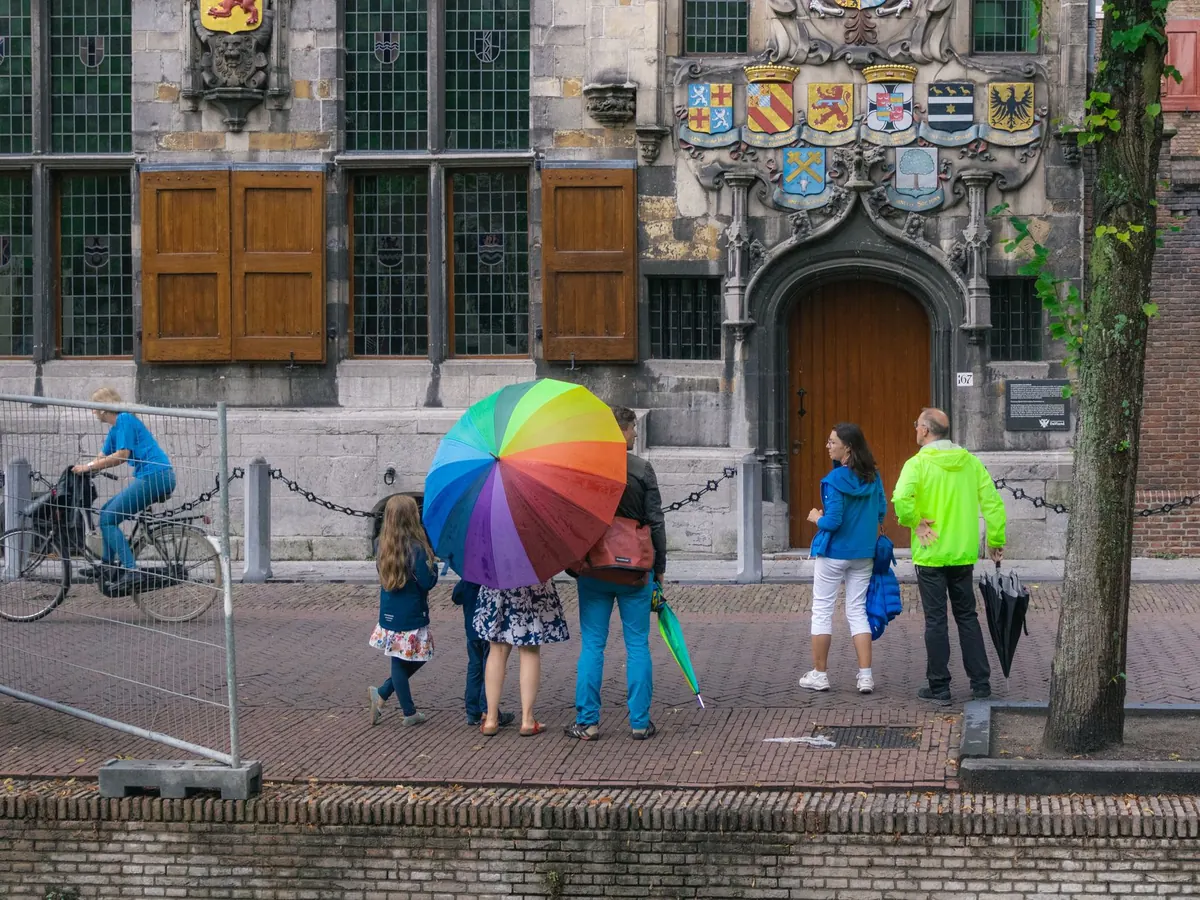
Walking with a child is a different calculation. You can hold the umbrella lower and closer, and a child tucks in under your arm. A 50-inch canopy handles that comfortably. For a buggy or pram, though, think differently: the canopy needs to cover you and the front of the pram, which usually means a golf size or a dedicated pram umbrella clipped to the frame.
Once you are sheltering three or more people, you are in golf umbrella territory: 60 to 68-inch arcs, often with a fibreglass frame and a vented double canopy. These genuinely do cover a small group standing still, which is why they are popular on the sidelines of a pitch.
Be realistic about the trade-offs. A 68-inch canopy is heavy, and it acts like a sail. In a gust, the wind load on that much fabric will twist your wrist or flip the canopy inside out. If your walk involves exposed corners or open ground, a big umbrella can be more trouble than two medium ones.
For a family of four, the honest answer is usually two umbrellas rather than one enormous one. You stay drier, you move faster, and nobody has to walk in the drip line.
Two canopies with identical arcs can behave very differently.
Think about how you actually move before you commit to a size.
Standing at a bus stop or a station platform, you can afford a big canopy because you are not walking into the wind. Commuting on foot through narrow pavements is the opposite: a wide umbrella catches on railings, other pedestrians and shopfronts, and you will end up carrying it closed. Getting in and out of cars favours a compact that folds small and opens one-handed.
Weight is the quiet deciding factor. A larger canopy with a steel frame can weigh twice what a smaller aluminium or fibreglass one does, and the leverage of a wide dome makes it feel heavier still by the end of a walk. If you have ever abandoned an umbrella because your arm ached, you bought too much canopy for the distance.
Measure your own shoulder width once, add a few inches either side, and remember that number. Then decide how many people will genuinely be under the canopy most of the time, not on the one day a year it rains hardest.
When you are in the shop, open the umbrella if you can, hold it above your head, and check where the rim sits relative to your shoulders. That single test tells you more than any label. Buy a canopy that reaches comfortably past your shoulders with a little tilt in hand, and you will stay dry on the days that matter.
Photo: Márton Novák / Pexels